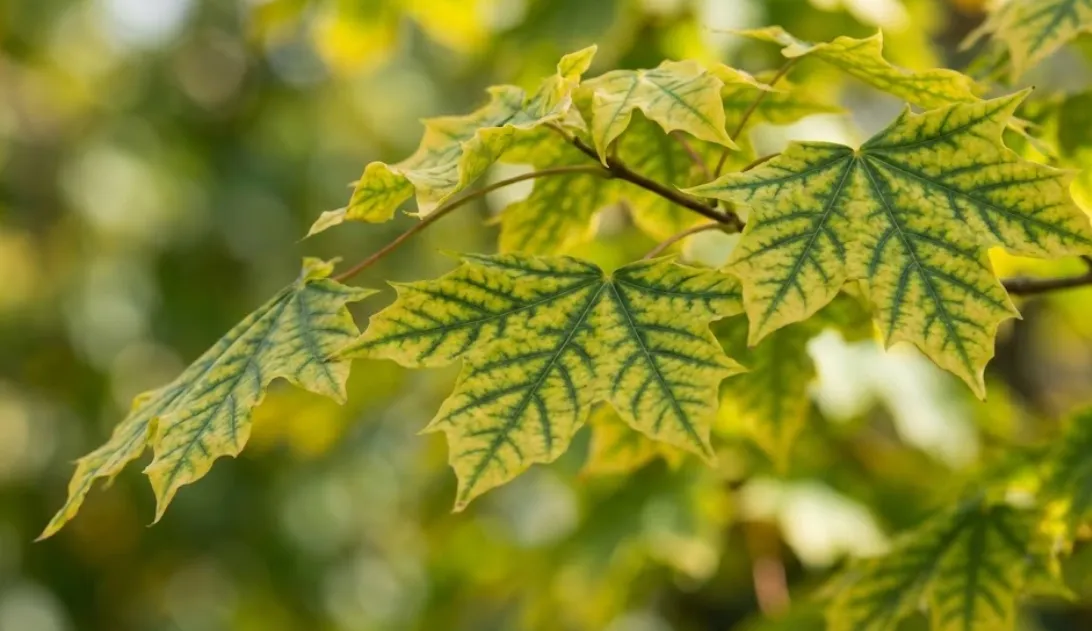
Noticing yellow leaves on your trees can trigger immediate concern for any property owner. Is your tree dying? Is it diseased? Or is this just a normal part of the tree’s lifecycle? Understanding the difference between harmless yellowing and warning signs of serious problems can save your trees and prevent costly mistakes.
Key Takeaways
- Chlorosis is the Cause: The yellowing of leaves, known as chlorosis, happens when the green pigment chlorophyll is not produced, indicating an underlying issue with the tree’s health.
- Normal vs. Problematic: Yellowing is normal during fall for deciduous trees and for minor needle shedding in evergreens. However, yellowing during the growing season, especially with patterns like green veins (interveinal chlorosis), signals problems like nutrient deficiencies or disease.
- Common Causes: The most frequent causes of problematic yellowing include nutrient deficiencies (iron, nitrogen), improper watering (too much or too little), compacted or damaged roots, and high soil pH, which makes nutrients unavailable.
- Diagnosis is Key: Before applying any treatment, it is critical to diagnose the specific cause. A soil test is often the first step to identify nutrient or pH issues, preventing incorrect treatments that could harm the tree further.
Yellow leaves appear for many reasons, ranging from perfectly natural seasonal changes to severe nutrient deficiencies and diseases that require immediate professional attention. The key is learning to read the signs your tree is giving you and knowing when to take action.
In this comprehensive guide, we’ll explore the common causes of yellow leaves, help you distinguish between normal and problematic yellowing, and provide expert advice on when to call a professional arborist.
Understanding Why Leaves Turn Yellow: The Science Behind Chlorosis
Before diving into specific causes, it’s helpful to understand the biological process behind yellowing leaves. The green color in leaves comes from chlorophyll, the pigment that enables photosynthesis. When chlorophyll production decreases or breaks down, the underlying yellow and orange pigments (carotenoids and xanthophylls) become visible.
This yellowing process is called chlorosis. While chlorosis is a symptom rather than a disease itself, it indicates that something is interfering with the tree’s ability to produce or maintain chlorophyll. The pattern, timing, and distribution of yellow leaves provide important clues about what’s happening with your tree.
Healthy trees maintain deep green foliage throughout the growing season, efficiently producing energy through photosynthesis. When you see yellow leaves outside of normal fall coloration, it’s your tree’s way of signaling that something in its environment or physiology has changed.
Normal Yellowing: When Yellow Leaves Are Nothing to Worry About
Fall Coloration in Deciduous Trees
The most common and completely normal cause of yellow leaves is autumn senescence in deciduous trees. As days shorten and temperatures drop in fall, deciduous trees prepare for winter dormancy by withdrawing nutrients from their leaves. Chlorophyll breaks down first, revealing the yellow and orange pigments that were present all along but masked by the dominant green.
This process is genetically programmed and perfectly healthy. Trees like birches, aspens, ginkgos, hickories, and many maples display spectacular yellow fall foliage as part of their natural annual cycle. If yellowing occurs in autumn, affects the entire tree uniformly, and is accompanied by seasonal leaf drop, this is normal and expected.
Natural Leaf Shedding in Evergreens
Evergreen trees also shed older needles regularly, though they do so less noticeably than deciduous trees. Pine, spruce, and fir trees typically retain needles for 2 to 4 years before shedding them. The oldest interior needles turn yellow or brown before dropping, usually in late summer or fall.
If yellowing on evergreens is limited to older, interior needles while new growth remains green and healthy, this is natural needle drop. However, if new growth yellows or entire branches lose their color, this signals a problem requiring investigation.
Transplant Shock
Newly planted or transplanted trees often experience some leaf yellowing as they adjust to their new location. This temporary stress response occurs because the root system was disturbed and cannot immediately supply adequate water and nutrients to all the foliage. Mild yellowing in the first growing season after transplanting is common and usually resolves as the tree establishes new roots.
Warning Signs: When Yellow Leaves Indicate Serious Problems
Pattern Recognition: What the Yellowing Tells You
The pattern and distribution of yellow leaves provide critical diagnostic information. According to the University of Illinois Extension, the location of the yellowing (new leaves vs. old leaves) is a key indicator of which nutrient may be deficient.
- Interveinal Chlorosis: (veins remain green while tissue between veins turns yellow) typically indicates iron deficiency, manganese deficiency, or other micronutrient issues.
- Uniform Yellowing: (entire leaf turns yellow evenly) often suggests nitrogen deficiency, root problems, or environmental stress.
- Spotty or Blotchy Yellowing: (irregular yellow patches) may indicate disease, pest damage, or chemical injury.
- Progressive Yellowing: (starting at leaf edges or tips) can signal drought stress, salt damage, or root problems.
Suddenly, rapid yellowing across the entire tree usually indicates a severe problem, such as root damage, girdling roots, or vascular disease.
Common Causes of Problematic Yellow Leaves
1. Nutrient Deficiencies
Nutrient deficiencies are among the most common causes of chlorosis in landscape trees. Different nutrients create distinctive yellowing patterns:
- Nitrogen Deficiency: Older leaves yellow first, starting from the bottom of the tree and progressing upward. The entire leaf turns pale yellow-green uniformly. Nitrogen is mobile within the plant, so the tree relocates it from older leaves to support new growth.
- Iron Deficiency: Young leaves show interveinal chlorosis with prominent green veins against yellow tissue. This is particularly common in pin oaks, silver maples, and other trees growing in alkaline soils, where iron becomes chemically unavailable even if present.
- Manganese Deficiency: Similar to iron deficiency with interveinal chlorosis, but typically affects mature leaves rather than just new growth. The pattern may be less distinct with broader areas of yellowing.
- Magnesium Deficiency: Older leaves yellow between the veins while leaf edges remain green. Yellowing progresses from older to younger leaves as the mobile nutrient is redistributed.
2. Soil pH Problems
In alkaline soils (pH above 7.5), iron, manganese, and other micronutrients become chemically locked in forms that tree roots cannot absorb. As experts at the South Dakota State University Extension explain, this leads to chlorosis even when the soil has adequate nutrients, simply because the high pH makes them unavailable to the tree.
Acid-loving trees like oaks, maples, and dogwoods are particularly susceptible to chlorosis in alkaline conditions. This is especially problematic in regions with naturally alkaline soils or where concrete, limestone, or repeated deicing salt application has raised soil pH.
3. Water Stress (Too Much or Too Little)
Both drought and overwatering can cause yellow leaves, though the mechanisms differ:
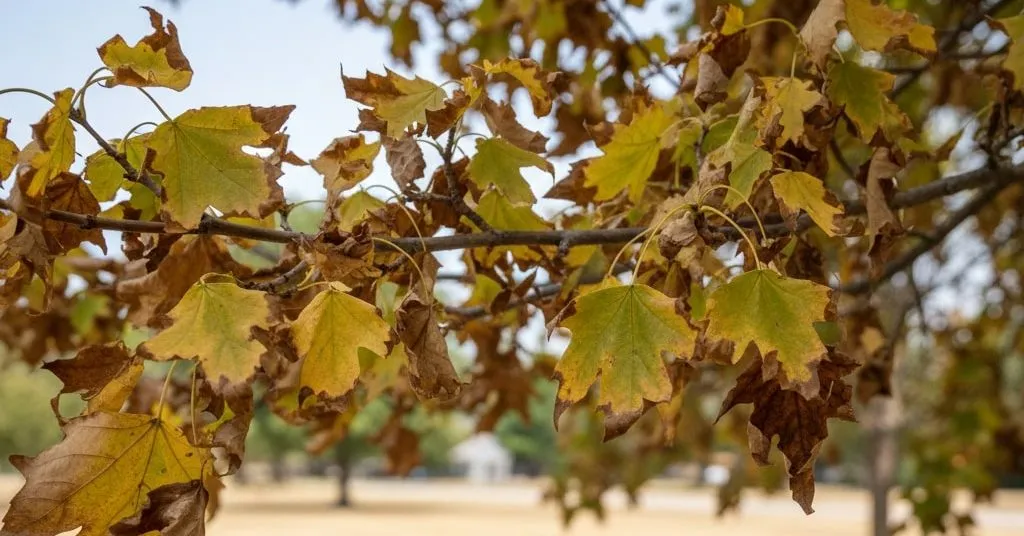
- Drought Stress: Insufficient water prevents nutrient uptake and causes leaves to yellow and wilt. Yellowing typically starts at leaf edges and progresses inward. Prolonged drought leads to premature leaf drop as the tree conserves resources.
- Overwatering and Poor Drainage: Waterlogged soil suffocates roots by eliminating soil oxygen. Root damage from drowning prevents water and nutrient absorption, ironically causing drought-like symptoms despite excess water. Overwatered trees show yellowing leaves, wilting, and often develop root rot diseases.
4. Root System Problems
The root system is the tree’s lifeline, and any damage significantly impacts foliage health:
- Root Damage: Construction activity, trenching, soil compaction, or physical injury can sever or damage roots. The affected portions of the canopy turn yellow and decline as they’re cut off from water and nutrient supplies.
- Girdling Roots: Roots that circle the trunk and constrict it create a bottleneck that restricts water and nutrient flow. This causes a gradual decline with yellowing foliage, reduced growth, and eventual tree death if uncorrected.
- Root Rot: Fungal diseases like Phytophthora, Armillaria, and others attack roots in poorly drained soils. Infected roots cannot function properly, causing widespread yellowing, wilting, and decline.
5. Diseases and Pests
Various diseases and pests cause yellowing as they damage foliage or disrupt the tree’s vascular system:
- Verticillium Wilt: This soil-borne fungal disease invades through roots and clogs the tree’s vascular system. Affected branches show yellowing leaves, wilting, and dieback. Maples, ashes, and many other species are susceptible.
- Dutch Elm Disease: Affects elm trees, causing yellowing and wilting of foliage as the fungus blocks water transport. Symptoms often appear first in one section of the canopy.
- Aphids, Spider Mites, and Scale Insects: These sap-sucking pests can cause yellowing, stippling, or general decline in foliage health. Heavy infestations weaken trees and may transmit diseases.
- Leaf Spot Diseases: Various fungal and bacterial leaf spots cause yellowing around infection sites before leaves drop prematurely.
6. Environmental Stressors
- Chemical Damage: Herbicide drift, soil contamination, or deicing salt can cause rapid yellowing and foliage damage. Road salt is particularly problematic, accumulating in soil and causing leaf burn and yellowing.
- Air Pollution: Ozone, sulfur dioxide, and other air pollutants can cause yellowing, stippling, and premature leaf drop, particularly in urban environments.
- Temperature Extremes: Unexpected frosts, heat waves, or sudden temperature fluctuations stress trees and may cause yellowing.
- Compacted Soil: Heavy foot or vehicle traffic compresses soil, eliminating air pockets and suffocating roots. This leads to chronic yellowing and decline.
How to Read Yellow Leaf Patterns: Fast Reference
| Yellowing Pattern | Timing | Affected Leaves | Likely Cause | Action Needed |
| Entire tree, uniform color | Fall season | All leaves equally | Normal fall coloration | None – natural process |
| Interior needles only | Late summer/fall | Oldest needles | Natural needle drop (evergreens) | None – natural process |
| Between veins, veins stay green | Growing season | New growth primarily | Iron or manganese deficiency | Soil test, pH adjustment, fertilization |
| Uniform pale yellow-green | Growing season | Older/lower leaves first | Nitrogen deficiency | Fertilization program |
| Starts at leaf edges | Summer | All affected leaves | Drought stress or salt damage | Improve watering, check drainage |
| Entire leaves, with wilting | Any time | Scattered throughout the canopy | Root problems or disease | Professional arborist evaluation |
| One section of the canopy | Growing season | Entire branches | Root damage or vascular disease | Immediate professional assessment |
| Spotty, irregular patches | Growing season | Random pattern | Disease, pest, or chemical damage | Identify the specific cause, and treat accordingly |
When to Call a Professional Arborist
While some yellowing is normal and manageable, certain situations require professional expertise:
- Yellowing appears suddenly and progresses rapidly across the tree
- Only one section or side of the tree shows symptoms
- Yellowing is accompanied by wilting, branch dieback, or bark abnormalities
- The pattern suggests vascular disease (one-sided symptoms, branch dieback)
- Previous treatments have failed to resolve the yellowing
- The tree is valuable, mature, or in a high-visibility location
- You’re unsure of the cause and want an accurate diagnosis
- Multiple trees on your property show similar symptoms
Professional arborists have the training and diagnostic tools to accurately identify the cause of yellowing and recommend appropriate treatments. Early intervention often makes the difference between saving a tree and losing it.
Treatment Options for Yellow Leaves
Treatment depends entirely on the underlying cause. Here are common approaches:
- Nutrient Deficiencies: Soil testing determines which nutrients are lacking or unavailable. Treatment may include fertilization, soil amendments to adjust pH, or foliar applications of deficient micronutrients. Iron chlorosis often requires soil acidification or chelated iron treatments.
- Water Management: Adjust irrigation to provide deep, infrequent watering. Improve drainage in waterlogged areas through grading, tile drains, or raised planting beds. Mulching helps retain moisture and moderate soil temperature.
- Soil Improvement: Core aeration relieves compaction. Adding organic matter improves soil structure, drainage, and nutrient availability. Proper mulching protects the root zone from temperature extremes and compaction.
- Disease Management: Fungal diseases may require fungicide applications, improved air circulation through pruning, or removal of infected plant material. Some diseases, like Dutch elm disease and verticillium wilt, have no cure, requiring tree removal to prevent spread.
- Pest Control: Identify specific pests and apply appropriate treatments. Integrated pest management (IPM) combines cultural, biological, and chemical controls for sustainable pest management.
- Root Care: Address girdling roots through careful excavation and pruning. Protect root zones during construction. Avoid soil compaction in critical root areas.
Frequently Asked Questions About Yellow Leaves on Trees
Why are my tree leaves turning yellow in summer?
Summer yellowing is not normal and indicates a problem. Common causes include nutrient deficiencies (especially iron or nitrogen), drought stress, root problems, or disease. The specific pattern and distribution of yellowing help diagnose the issue. A professional evaluation can identify the cause and recommend appropriate treatment.
Can yellow leaves turn green again?
Once a leaf has turned fully yellow, it cannot regain its green color. However, treating the underlying cause will result in healthy green foliage on new growth. For nutrient deficiencies, improvements may be visible within weeks to months as the tree responds to treatment. The yellow leaves will eventually drop and be replaced by healthy new foliage.
Should I remove yellow leaves from my tree?
In most cases, it’s best to leave yellow leaves on the tree until they drop naturally. The tree is reabsorbing nutrients from those leaves before shedding them. Prematurely removing leaves interferes with this nutrient recycling process. The exception is leaves affected by disease, which should be removed and disposed of to prevent disease spread.
How do I know if my tree is getting too much or too little water?
Both overwatering and underwatering can cause yellow leaves, but there are distinguishing signs. Underwatered trees show yellowing that starts at leaf edges, with leaves that feel dry and crispy. The soil is dry several inches below the surface. Overwatered trees have yellow leaves that feel soft or soggy, and the soil remains constantly wet. Root rot odors and fungal growth may be present in waterlogged conditions.
What’s the difference between iron deficiency and nitrogen deficiency?
Iron deficiency causes interveinal chlorosis, where the tissue between leaf veins turns yellow while the veins remain distinctly green. This pattern appears first on new growth. Nitrogen deficiency causes uniform yellowing of entire leaves, starting with older, lower leaves and progressing upward. The entire leaf becomes pale yellow-green without the green vein pattern.
Can I fertilize a tree with yellow leaves?
Fertilization can help if nutrient deficiency is the cause, but applying fertilizer without knowing the problem can worsen the situation or waste money. Too much fertilizer can burn roots and increase stress. Always conduct a soil test first to identify specific deficiencies and pH issues. Treat the confirmed problem rather than guessing.
Are yellow leaves a sign my tree is dying?
Not necessarily. Yellow leaves can indicate anything from normal fall coloration to temporary stress to serious disease. The context matters: timing, pattern, progression, and accompanying symptoms all help determine severity. Many causes of yellowing are treatable if caught early. However, rapid, widespread yellowing with wilting and dieback does signal serious problems requiring immediate professional evaluation.
How long does it take for a tree to recover from a nutrient deficiency?
Recovery time varies by tree species, severity of deficiency, and treatment method. With proper treatment, you may see improvement in new growth within 4 to 8 weeks. Complete recovery, where the entire canopy returns to healthy green foliage, typically takes one to two growing seasons. Severely deficient trees may require several years of consistent treatment to fully recover.
Prevention: Keeping Your Trees Healthy and Green
Preventing yellow leaf problems is always easier and less expensive than treating them after they occur:
- Proper Planting: Choose tree species suited to your soil type and site conditions. Plant at the correct depth with the root flare visible. Avoid planting in areas prone to waterlogging or near sources of soil contamination.
- Soil Management: Test soil pH and nutrient levels before planting and periodically thereafter. Amend soil as needed to maintain optimal conditions for your specific tree species. Add organic matter annually to improve soil structure.
- Mulching: Maintain a 2-to-4-inch layer of organic mulch around trees, keeping it several inches away from the trunk. Mulch moderates soil temperature, retains moisture, suppresses weeds, and adds nutrients as it decomposes.
- Proper Watering: Water deeply and infrequently to encourage deep root growth. Adjust watering based on rainfall, temperature, and tree needs. Ensure good drainage to prevent waterlogging.
- Regular Monitoring: Inspect trees regularly for early signs of problems. Early detection allows for prompt treatment before minor issues become major problems.
- Professional Tree Care: Schedule periodic inspections with a Licensed and Insured tree service, especially for valuable or mature trees. Professional care includes proper pruning, disease prevention, and addressing potential problems before they become serious.
Trust McKay Tree Service for Expert Tree Health Care
Yellow leaves don’t have to mean disaster for your trees. With proper diagnosis and timely treatment, most yellowing issues can be resolved, restoring your trees to vibrant health. The key is understanding what your tree is telling you and taking appropriate action.
Don’t wait until yellow leaves become bare branches. Early intervention saves trees, time, and money. Our Licensed and Insured arborists at McKay Tree Service have the expertise to accurately diagnose leaf yellowing problems and develop effective treatment plans tailored to your trees’ specific needs.