Key Takeaways
- Immediate Hazards: Any tree in contact with power lines, leaning precariously over a structure, or blocking emergency access requires immediate professional intervention.
- Structural Red Flags: Deep trunk cracks, hollow cavities, and lifting root plates are signs of “imminent failure.”
- The Post-Storm Audit: High winds and heavy rains often reveal hidden weaknesses; a post-storm inspection is vital for early detection.
- Liability Management: Delaying the removal of a known hazard can lead to insurance claim denials and increased personal liability.
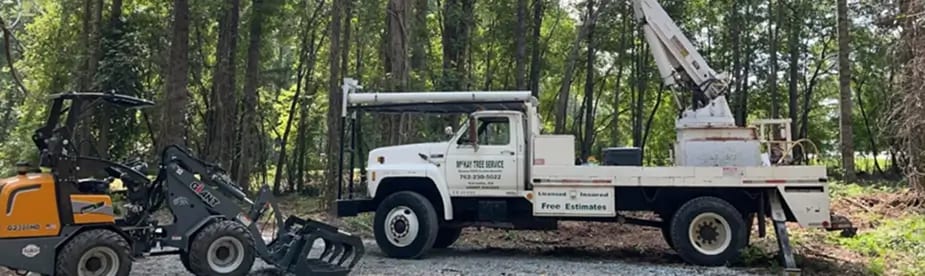
- The Power of Precision: Emergency removals often require specialized rigging and cranes to prevent further property damage during the extraction process.
For homeowners in Habersham County and the surrounding North Georgia region, our towering hardwoods and dense pines are a source of pride and beauty. However, when the weather turns or when silent decay finally takes its toll, those same trees can transform into high-risk liabilities. Knowing the difference between a tree that needs “routine maintenance” and one that requires an “emergency response” is the difference between a safe home and a catastrophic property loss.
Defining a Tree Emergency
Not every tree issue is an emergency, but when a tree’s structural integrity is compromised near a “target” (your home, car, or a public walkway), time becomes your greatest enemy. An emergency removal is defined by imminent risk. If the tree is likely to fall before a standard appointment can be scheduled, or if it has already fallen and is causing a secondary hazard, you are in an emergency scenario.
1. Structural Failures: The “Silent” Emergencies
Sometimes the most dangerous trees aren’t the ones that have already fallen, but the ones that are about to. Look for these critical structural red flags:
- Vertical Trunk Cracks: A deep, vertical split that goes through the bark and into the structural wood is a sign that the tree is pulling itself apart. If you can see “into” the tree, it is an emergency.
- Heaving Root Plates: Look at the soil at the base of the tree. If the ground is mounding up or “lifting” on one side while the tree leans on the other, the root system has snapped. This tree is no longer anchored and can fall at any moment.
- The “Hanging” Limb: Often called “widow-makers,” large limbs that have snapped but are still caught in the canopy are ticking time bombs. A slight breeze can dislodge them, sending hundreds of pounds of wood crashing down.
2. Storm Damage: The Aftermath
Georgia is no stranger to volatile weather. From the ice storms of winter to the sudden, violent thunderstorms of spring, our trees take a beating. After a significant weather event, you should call for an emergency assessment if you notice:
- New Leaning: If a tree was straight yesterday and is leaning today, its foundation has failed.
- Lightning Strikes: A lightning-struck tree often suffers internal “explosions” of sap and water. Even if it looks standing, the structural integrity is often shattered, and the tree can die and become brittle with shocking speed.
- Entanglement with Utilities: Never approach a tree touching a power line. This is a life-threatening emergency. Contact your utility provider first, followed by an emergency tree service firm equipped to work around high-voltage lines.
3. Obstruction and Access
An emergency isn’t always about a tree falling on a house. It can also be about access. If a tree has fallen across your only driveway, you are effectively trapped. This is an emergency for medical reasons and fire safety. Similarly, trees blocking public sidewalks or roads in neighborhoods like Clarkesville or Cornelia require rapid removal to restore the flow of traffic and emergency services.
The Risk of the “Wait and See” Approach
Many homeowners hesitate to call for emergency service due to cost concerns. However, the financial reality of a fallen tree is far more taxing.
- Insurance Complications: Most insurance policies cover “Acts of God.” However, if a tree was visibly dead, rotting, or leaning for months and the homeowner did nothing, the insurance company may argue “negligence,” potentially leaving you to foot the bill for both the tree removal and the home repairs.
- Increasing Danger: A compromised tree becomes more unstable with every passing hour. What starts as a simple removal can turn into a complex, crane-assisted operation if the tree begins to collapse further.
Why Professional Precision is Non-Negotiable
Emergency tree removal is not a DIY project. It involves high-tension wood, unpredictable weight distributions, and often dangerous weather conditions. Professional crews use:
- Precision Rigging: To ensure that sections of the tree are lowered safely without impacting the remaining structure.
- Cranes and Buckets: To reach high-risk limbs without putting a climber into a failing canopy.
- Technical Expertise: Understanding how wood reacts under “compression” and “tension” to prevent the tree from “barber-chairing” or snapping back toward the operator.
Frequently Asked Questions
How quickly can an emergency crew arrive?
Most reputable local services prioritize emergency calls and aim to have a crew on-site within a few hours to stabilize the situation, especially if a structure is involved.
Will my homeowners’ insurance cover emergency tree removal?
Generally, if the tree falls on a “covered structure” (like your house, garage, or fence) due to a storm, insurance typically covers the removal. If it falls in the yard without hitting anything, coverage varies.
What should I do while waiting for the crew?
Stay clear of the “fall zone” – a radius at least 1.5 times the height of the tree. Keep children and pets indoors and, if power lines are involved, stay at least 30 feet away.
Can a tree be saved after it starts leaning?
In rare cases involving young trees and minor soil shifting, “staking” might work. However, for mature hardwoods in Georgia’s clay soil, a sudden lean almost always necessitates removal.
What is the “No Leaf Left Behind” guarantee?
It is a commitment to total property restoration. After the emergency is over, the crew clears all twigs, sawdust, and debris so your yard is returned to its original state.
Conclusion: Act Before the Impact
Emergency tree removal is about more than just cutting wood; it’s about restoring safety and peace of mind. By recognizing the signs of imminent failure, the heaving roots, the deep cracks, and the storm-damaged limbs, you can take action before the “Act of God” becomes a personal disaster.
Do you have a tree threatening your home right now? Don’t wait for the next gust to turn a hazard into a catastrophe. McKay Tree Service provides rapid-response emergency tree removal throughout Habersham County and North Georgia. Our experienced team utilizes specialized rigging and high-capacity equipment to handle even the most precarious removals safely and efficiently. Whether you’re dealing with a fallen oak on your roof or a dangerous “widow-maker” over your driveway, we deliver the professional, localized service Clarkesville and Cornelia trust.